
Routines Of Peace 1/4: But first, know thyself!
When generic 'self care' practices just don't hit, how can we build a real connection back to ourselves?

“In the midst of winter, I found there was, within me, an invincible summer.
And that makes me happy. For it says that no matter how hard the world pushes against me, within me, there’s something stronger – something better, pushing right back.”
- Albert Camus
When you believe that there is a center to you that is your true essence - an internal leader that can’t be shaken by the aggressive agendas, insecurities, or flights of whimsy that your other internalised belief systems and learned defences push at you throughout your life - you’ve located You.
Dick Schwartz (the brain behind Internal Family Systems) set up ‘8 C’s’ to characterize the ‘Self’ - as he refers to it - Calm, Clarity, Compassion, Curiosity, Confidence, Courage, Creativity, Connectedness.
Carl Jung also referred to this ‘Self’ against a similar framework.
Stoic philosophy says ‘inner citadel’ (which is frikkin’ sweet tbh), Buddhists - “True nature/Wise mind”, Camus’ invincible summer (lovely!).
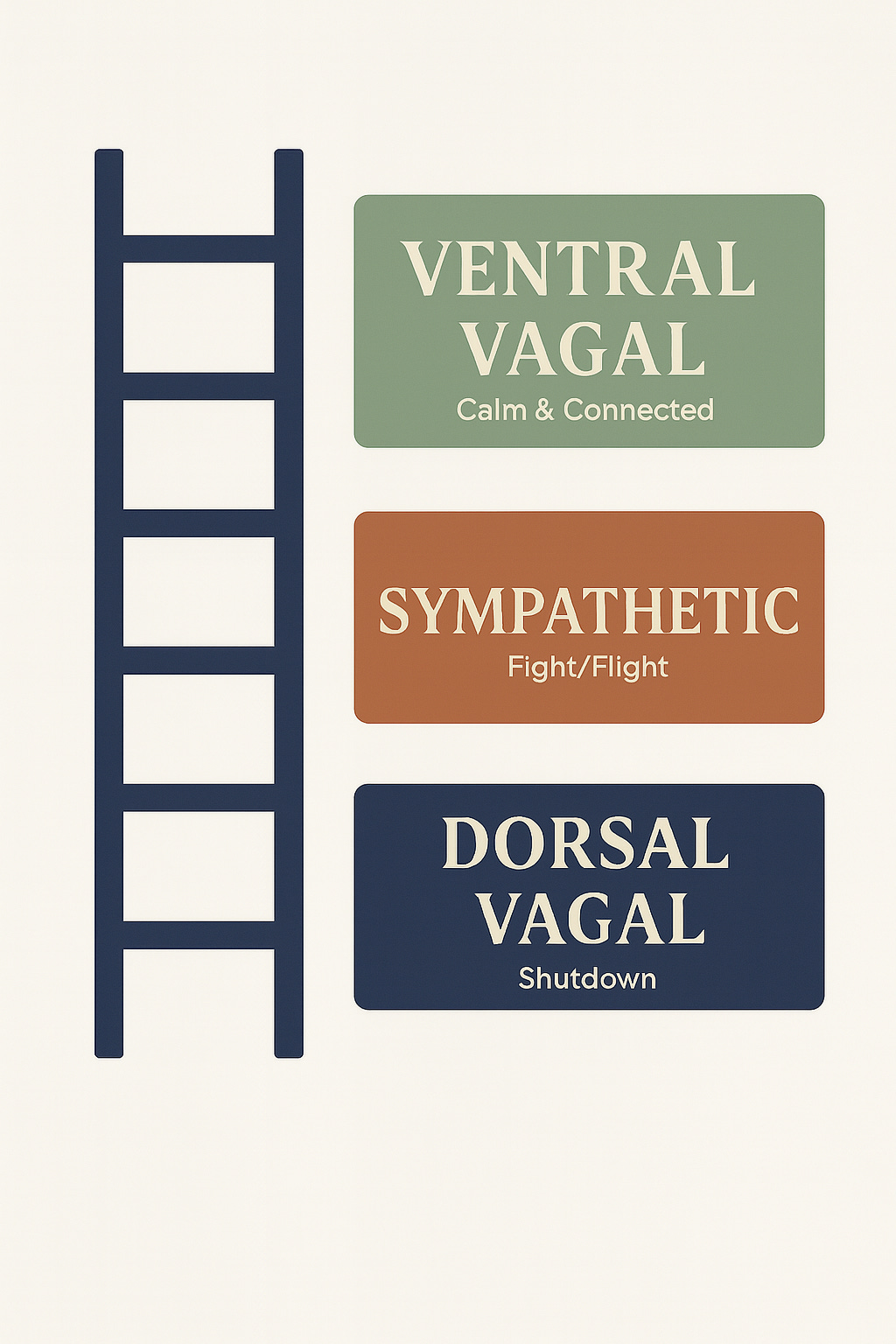
For neurophysiological flavour, when studying with the Polyvagal Institute we identified this as “Ventral Vagal” or “top of the ladder” (see below) - a nervous system state you access from a felt sense of safety.
You get the idea.
Buuuut - do you feel like you know this place, this you, beyond just an idea or concept?
I will tell you for free - I did not. Somedays, I still fumble for it’s location - and that is why I put my heart into this continued exploration. Coming from a family with a history of substance abuse issues, I always felt deeply cautious of falling into that ‘hole’. I would be in the last half of my twenties before I realised the hole was disconnection from myself, and as a result, a disconnection from others - and I was already there.
Any habit that came after that was not falling in the hole itself, but something to make me feel slightly better about already being down there. I felt lonely even around people, lacked confidence in all areas of my life, and accepted a lot of BS, both from myself and others. I just felt this consistent seam of discomfort, a sort of anxious sadness about myself, most of the time. It ate at my resilience - if just managing how I felt about myself felt this big, how could I take on more in life?! As any person with a strong sense that there was something wrong with them does - I set off to fix this self-hating me, as well as all of the other things about me that were hate-worthy, by force. I would be confident and self loving (as I envisioned these happy & successful people were) if I had to beat it into myself, goddamnit!
Hmmm…what could go wrong?
We all have patterns and conditioning we have learned that stand in the way of our own growth. But our focus on performing and ‘fixing’ ourselves, is detouring us from remembering what we already know - how to be at peace as the flawed, fully human us.
How to crawl out of the hole by reconnecting & understanding over fixing.
Time and time again, humanity has shown its capacity for growth, innovation, love and the prioritization of community that creates deep internal satisfaction. We’ve also shown our talent for creating holes - the ways we cover, avoid, and repress pain, scrape through in survival mode, and then inevitably go on to cause pain to others, while simultaneously damaging our self relationship.
Hurt people, hurt people - and themselves. Find me a truer truth!
While I get how adaptation is an important ability for a mammal like me (it does serve us well) we often lose the very important second half of the equation when it comes to real growth - which is to process and grow through pain after injury.
We’ve gotten stuck in performing facades and perpetual defence. We don’t feel safe, we won’t face why we don’t feel safe, so we can’t move beyond that place. We have just learned to ‘manage’ (survive) those painful areas. We become less connected and empathetic as a result.
Looking around the world might leave you cynical as to whether all of us have innate wisdom or the ability to process and integrate pain - and I won’t pretend I don’t have my own doubts. However, the perspective I try to remind myself of on shitty days (both created by me, or by others) is that the displays of desperation, thoughtlessness and callousness are a constant reminder we all have work to do, and the work we do in our own backyard is vital. We must all remember what we have forgotten - the drastic increase in our capacity for love, humility and growth when we maintain a conscious relationship to ourselves.
I also like to remind myself to make my peace with this being a lifelong practice, lest I fall into delusion that I have ‘graduated’, and achieved superiority**. Queen of the World in an alluring fantasy job title (especially to a Leo!) - but a fantasy nonetheless.
So, how to start connecting to ourselves more directly so we can close this loop - this equation of growth? How do we remember what we have always known innately - the inner citadel, Wise Mind, 8C’s, invincible summer - you?
Down below is the first of four ways that I’ve found effective, that I’ll share all four throughout this series - Routines of Peace (parts 1-3):
Understanding how you currently manage gives you insight into why you manage
Unlearning performance based self care and fixation on fixing
Step into my toolshed: Building a support kit that actually works
The one where you make a list: Losing something to gain The Thing
**this is the navel gazey, self absorbed place that people may fear when they hear/read the words ‘self relationship’. Self obsession/fixation is just another way to manage pain that makes it difficult to connect to the best version of ourselves, or other people.
Understanding how you currently manage gives you insight into why you manage
Sometimes we’ve learned how to process our emotions in ways that further our growth & our peace, sometimes we just ‘manage’ those feelings by repressing, avoiding, buying a new car, dyeing our hair etc.
You can clear the path to yourself by inviting what you find uncomfortable and unacceptable about you to the table, to be understood. It is bringing the perceived enemy into the fold. It is looking directly at the ick things.
It’s the opposite of what we are usually inclined to do.
Really understanding our current ways of managing, allows us to create support (‘self care’) that actually hits on the things we need when we feel distressed, not just a list of arbitrary activities that we tick off every day, week, or year.
When we can support ourselves through stress, we can reflect and identify what needs to change quicker and with more discernment because we can process discomfort more confidently.
In practice
If you don’t feel confident processing pain & discomfort, this exercise may help.
Identify how you manage discomfort (irritability, exhaustion, sadness, anxiety, loss etc) - and why this may be a ‘go-to’ habit or reaction when that discomfort comes up.
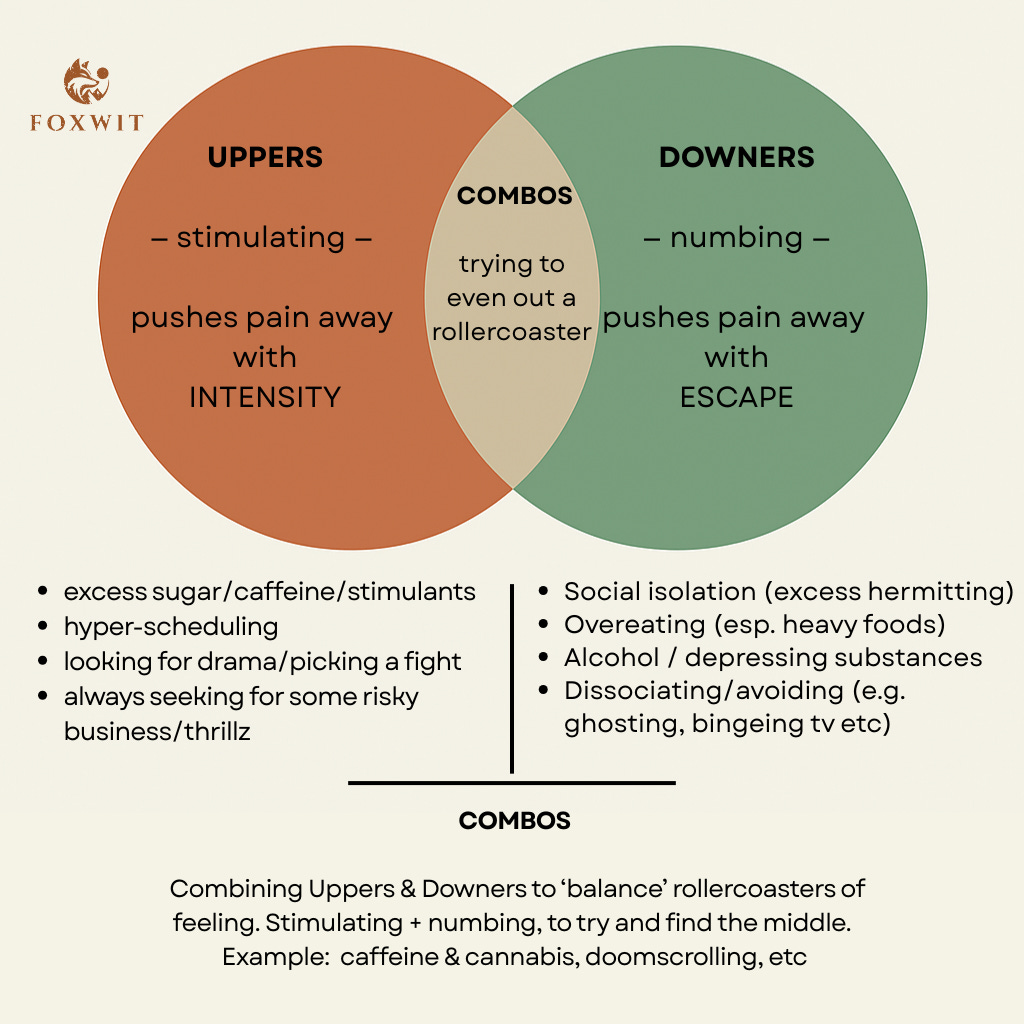
Consider this exquisite Venn I prepared as a prompt (not a set of rules)
Make the intention to reserve judgement, ‘coulda, woulda, shouldas’ etc. The objective is to gain understanding, not self flagellate.
Write a few sentences about a ‘go-to’ habit you don’t think is in your best interest. Anything that comes to mind, write freely.
Answer these questions (reserving judgement). Again, anything that comes to mind, write freely.
How does doing this thing benefit me? E.g “When I feel overwhelmed/depressed/uncertain/jealous/etc, it makes me feel X instead”
Why does doing this work for me? E.g is it stimulating when you feel down, numbing when you feel really anxious? What is the effect it provides to achieve the desired feeling that you listed in (a)?
Additional notes:
Being present feels weird sometimes... Stories may arise about how dumb it is, waste of time, what even is presence??? etc.
To share my own perspective on this feeling - I usually choose to question it, have a bit of curiosity when I feel resistance while trying something new or uncomfortable. This doesn't mean doing a bunch of things you think are genuinely useless - but just being curious about why you think something is stupid before writing off the entire thing is always a good idea (that leads into expanding our capacity for grey & not just black and white/this or that type thinking).
Writing freely is a skill. We often reflexively censor ourselves. Writing can have huge benefits for gaining insight & emotional release when you just let rip! Refrain from editing or re-drafting as you write.
Now you know a little bit more about what you need when you are experiencing stress or pain, based on how and why your current go-to habits are useful to you.
In part two I will explore how you can use that knowledge to build a support system that works.
See you there!
- Jasmine